Comparisons
Orbitagents vs Paperclip: Which Should Run Your AI Agents?
An in-depth, honest review of the two platforms that treat agents like a company: how they work, where each one wins, and which one fits you.
Paperclip and Orbitagents get compared a lot, and it is easy to see why. Both treat AI agents less like chatbots and more like a company. Both give agents schedules, goals and a place where a human stays in charge. Both like the words "operating system."
But they start from opposite ends.
Paperclip says it plainly in its own README: "We don't tell you how to build agents. We tell you how to run a company made of them." You bring the agents. Paperclip gives them an org chart, budgets and a board to answer to.
Orbitagents starts with the work. It gives your business AI agents that manage your growth: finding customers, outreach, social media and marketing, with the tools, memory and schedule already in place.
So the real question is not which one is better. It is which end you want to start from. This review goes through both, point by point, using each product's own documentation as of November 2026.
The short answer
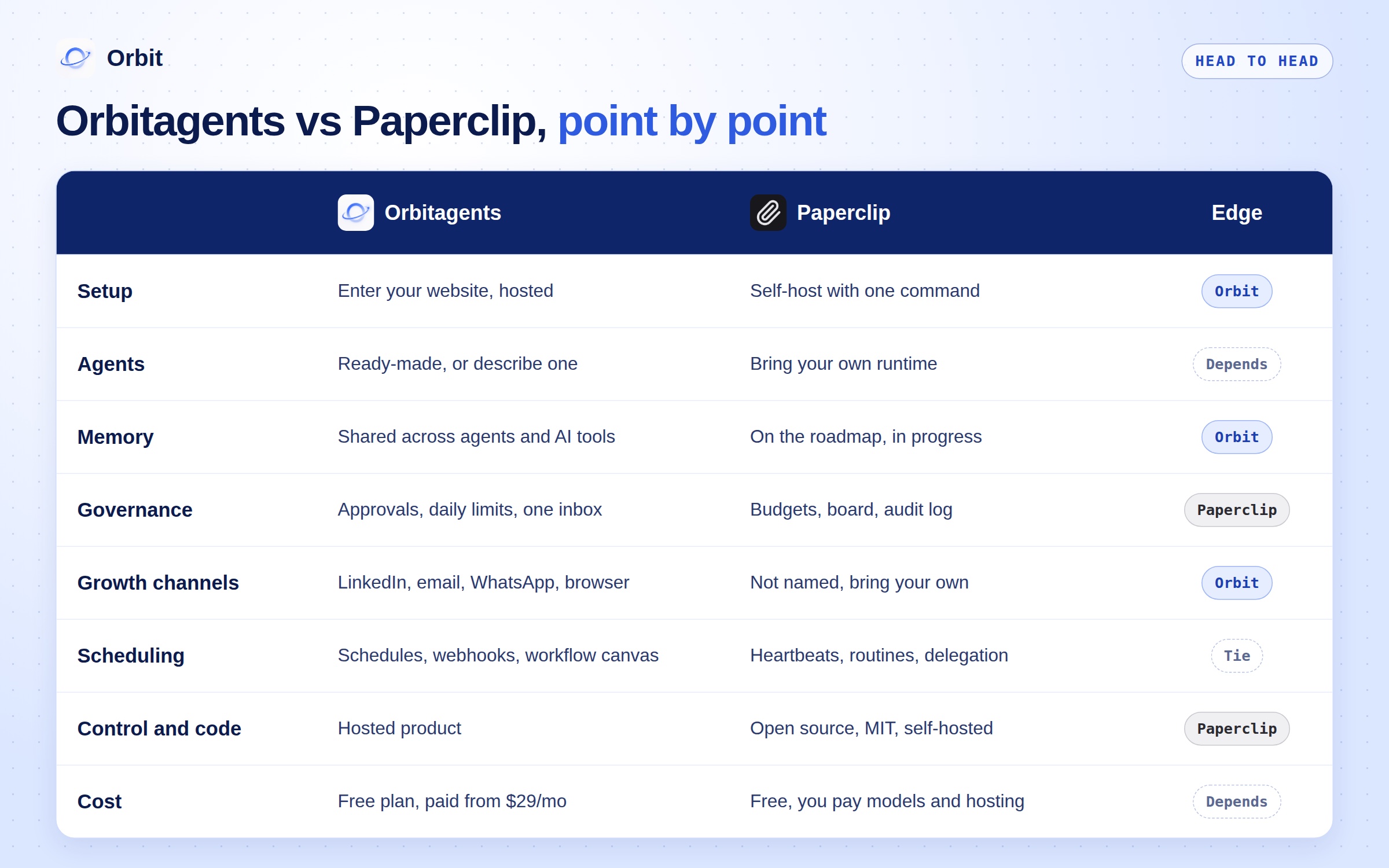
| Paperclip | Orbitagents | |
|---|---|---|
| In one line | A company structure for the agents you bring | Agents that manage your growth, ready to run |
| Best for | Technical founders who want to self-host and control every piece | Founders and small teams who want marketing and sales done |
| Setup | Install and run it yourself, connect your own agents | Enter your website and pick an agent |
| Agents | You bring them: Claude Code, Codex, Cursor, OpenClaw and more | Ready-made agents, or describe your own |
| Memory | On the roadmap, marked in progress | Shared memory across every agent and AI tool |
| Governance | Strong: org chart, budgets, board approvals | Approvals, daily limits, one inbox |
| Hosting | Self-hosted, cloud on a waitlist | Hosted, runs in Orbit's cloud |
| Price | Free and open source, you pay for models and hosting | Free plan, paid from $29 a month |
If you only read one table, read that one. The rest of this post explains each row.
What Paperclip is
Paperclip is an open-source app for running teams of AI agents. Its headline is "A team of agents for every person," and its tagline goes further: "If OpenClaw is an employee, Paperclip is the company." It is MIT licensed, runs as a Node.js server with a web dashboard, and has real momentum, with over 110,000 stars on GitHub.
The idea is to organize agents the way you would organize people.
- Org chart. Agents get a role, a manager and reporting lines. A CEO agent proposes a strategy for you to approve.
- Goals. Every task traces back to a company goal, so agents know why they are doing it.
- Heartbeats. Agents wake on a schedule, when they are assigned a task, or when they are mentioned.
- Budgets. Each agent gets a monthly budget, with a warning at 80% and an automatic pause at 100%.
- Governance. You act as the board. New agent hires need your approval by default, and you can pause or reassign work.
- Tickets. Every task has an owner, a thread and an append-only audit log.
- Gateway permissions. Each connection action can be set to Allowed, Ask first or Off.
It works with almost any agent runtime: Claude Code, Codex, Cursor, Gemini CLI, OpenCode, Hermes, OpenClaw, Kimi Code and more. If it can receive a heartbeat, in Paperclip's words, it is hired.
What Orbitagents is
Orbitagents, or Orbit for short, is an operating system for AI agents built around one job: growing your business. You enter your website, Orbit works out who your buyers are, and you pick an agent or describe one. It finds customers on LinkedIn, Reddit and X, runs outreach, writes posts in your voice and keeps your marketing moving every day.
Underneath, every agent shares one memory, starts each run already briefed on your business, and reaches built-in tools with no API keys. Agents run in Orbit's cloud with your laptop closed, and everything they do lands in one inbox for you to review. Orbie, your AI CMO, sits on top as the strategist you can talk to or call.
We explained the whole thing, and how it started, in What Is Orbitagents?
Head to head
1. Setup and hosting
Paperclip runs on your own machine or server. The quick start is one command, npx paperclipai onboard --yes, which needs Node.js 24.11 or newer and sets up an embedded database. For production you point it at your own Postgres and deploy it wherever you like. There is no Paperclip account, which is great for privacy and control. A cloud version is on a waitlist.
Orbit is hosted. You sign up, enter your website and the first agent can be working in about a minute. Nothing to install, and nothing to keep running.
Verdict: Paperclip if you want to own the stack. Orbit if you want to skip it.
2. Who builds the agents
This is the biggest difference between the two.
Paperclip manages agents but does not provide them. You connect a runtime such as Claude Code or Codex, write its instructions, and give it access to the tools it needs. That is powerful if you already have agents you like, and it means Paperclip works with almost anything. It also means the quality of the work depends on what you bring.
Orbit gives you agents that already know how to do the job: a LinkedIn growth agent, a lead finder, cold email, a Reddit agent, an X ghostwriter, meeting prep and more. If you want something else, you describe the job in a sentence and Orbit proposes the name, goal, schedule and tools, then builds it once you agree.
Verdict: Paperclip for people who want to build. Orbit for people who want the work done.
3. Memory and context
We think this is the part that decides whether agents work over weeks, not just in a demo. An agent with no memory is a new hire on their first day, every day. We went deep on why in our guide to context engineering.
Paperclip gives every task context that traces back to the company mission, and its docs say agents use a skill file to discover the context they need. Tickets keep a full thread and history. But persistent memory and a shared knowledge base are not described as features yet. On Paperclip's own roadmap, "Memory / Knowledge" is marked as partly done.
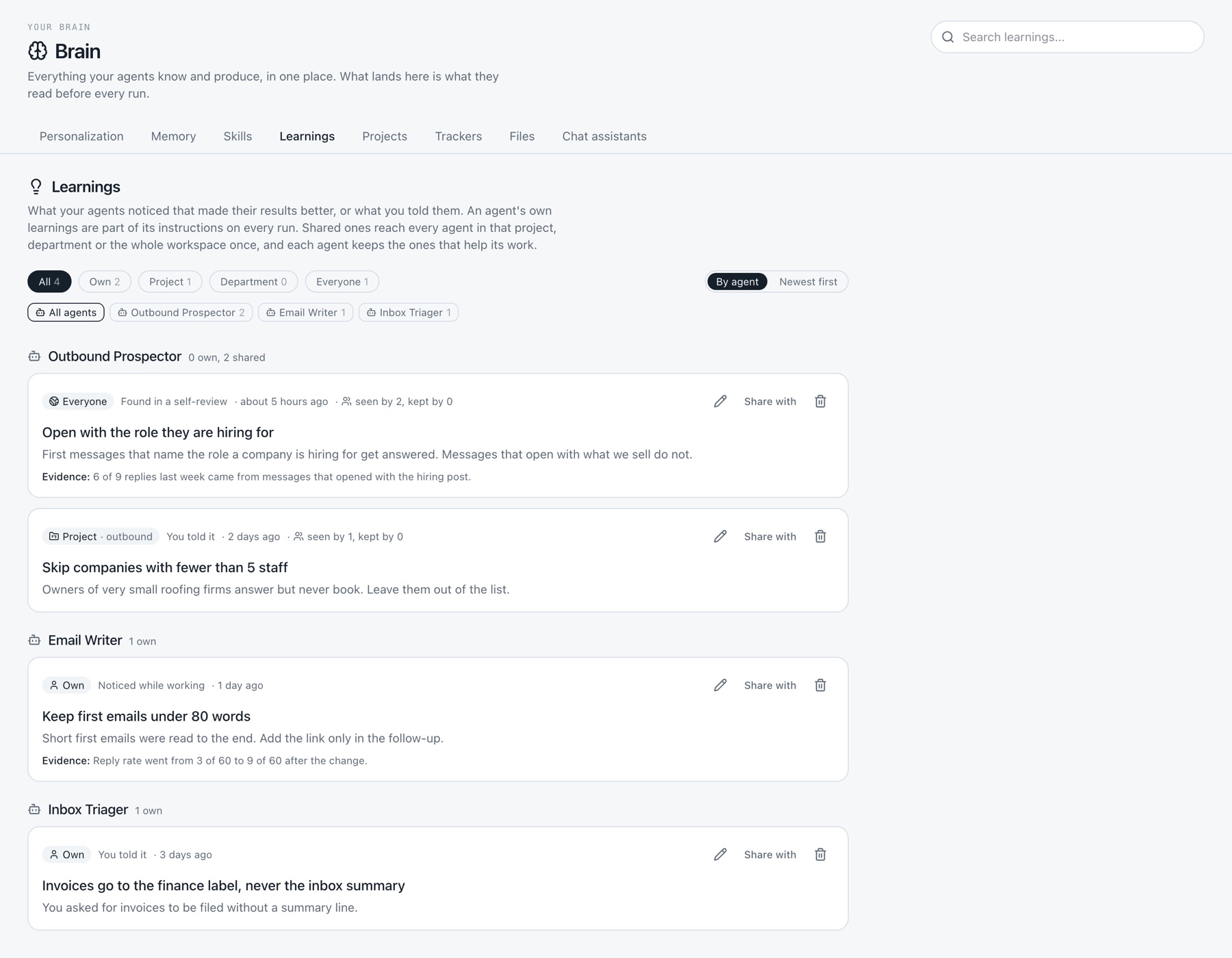
Orbit started as a shared memory, so this is where it is strongest. Every agent and every connected AI tool reads and writes one memory, searched by keyword and meaning and ranked by trust, and your own edits always outrank an agent's. Before every run, Orbit assembles a briefing with your company facts, core documents, decisions and the memories most relevant to that task.
Verdict: Orbit, clearly, for now. Watch Paperclip's roadmap.
4. Governance and cost control
Paperclip is excellent here, and it is fair to say it is ahead. Budgets per company, per agent and per project, with hard stops. A board that approves hires. Review stages before work counts as done. An append-only audit log. Allowed, Ask first or Off on every connection action. If you worry about runaway agents burning money, Paperclip was built with you in mind. One caveat from its own docs: new connections start as Allowed, including writes, so you need to switch outward actions to Ask first yourself.
Orbit keeps you in charge in a different way. Drafts can wait for your yes before anything is sent, every connected account has daily limits, and anything that needs you lands in one inbox. Each run has hard limits on time, tool calls and spend, and you can see what every credit went to.
Verdict: Paperclip has the deeper governance model. Orbit has the simpler one.
5. Tools and channels
Paperclip connects to GitHub, Notion, Railway and any custom MCP server, and its chat and email connectors (Slack, Discord, Telegram and AgentMail) are marked experimental. Its sales and marketing page describes research and content agents, but it does not name LinkedIn, email providers, CRMs or social platforms as integrations. For outreach, you build or bring that part.
Orbit is built for the channels where customers are. Agents can work in your LinkedIn, Gmail, Outlook, WhatsApp, Telegram and more, within daily limits per platform, such as 20 LinkedIn invites and 50 messages a day. Lead data from Apollo and LinkedIn, Reddit and X data, web scraping, and image, video and voice generation are built in with no API keys. For any site without an integration, agents drive a real browser you can watch live.
Verdict: Orbit for growth work. Paperclip for engineering and internal tools.
6. Scheduling and workflows
Both are strong here.
Paperclip has heartbeats and routines: scheduled, webhook or API-triggered tasks, with delegation moving up and down the org chart.
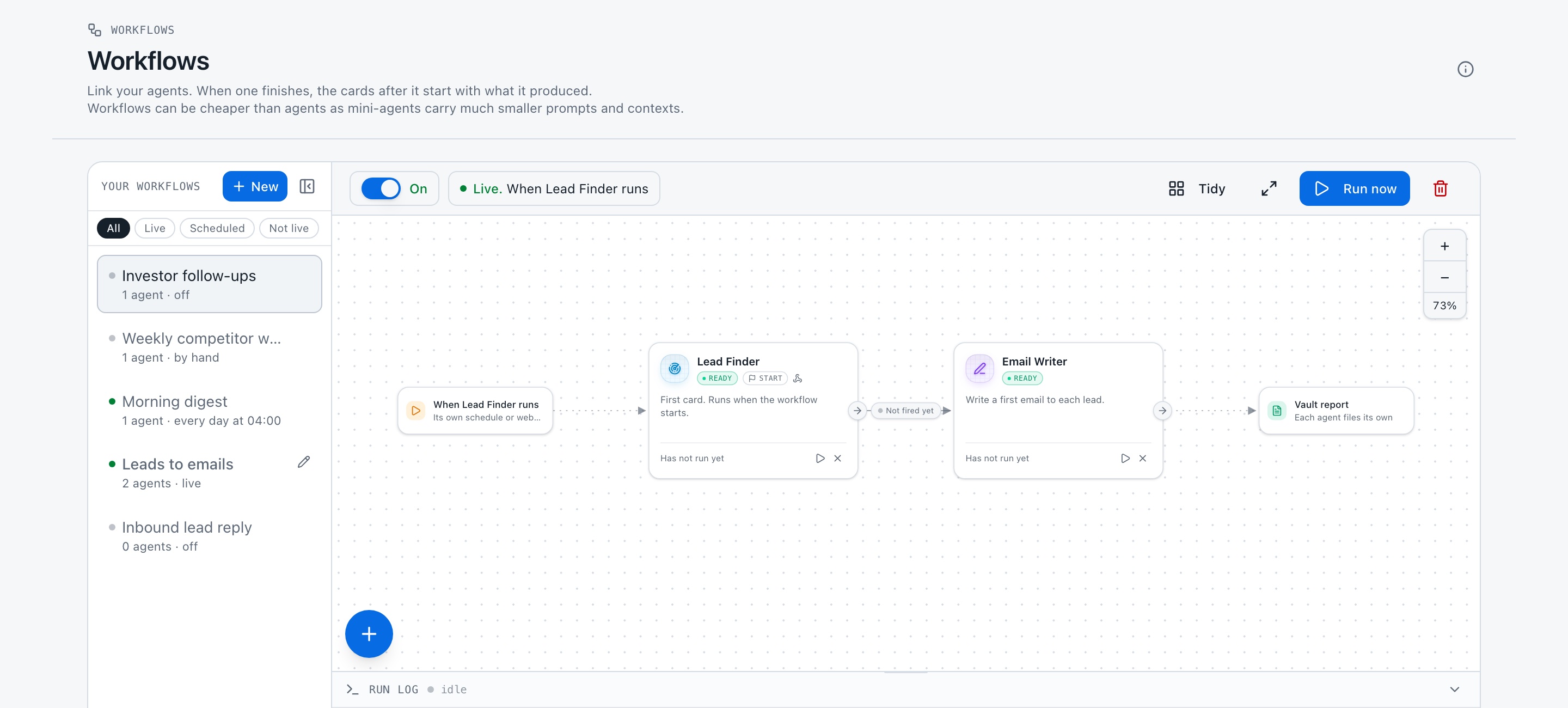
Orbit has schedules from hourly to custom timing, webhooks, agents that start after another one finishes, and a workflow canvas where you can see the handoffs.
Verdict: A tie. Paperclip's org-chart delegation is unique. Orbit's canvas is easier to read.
7. Talking to your agents
Paperclip keeps conversations attached to tasks, plans and decisions, and its own docs say clearly that it is not a chatbot. Agent Chat is listed on the roadmap as partly done.
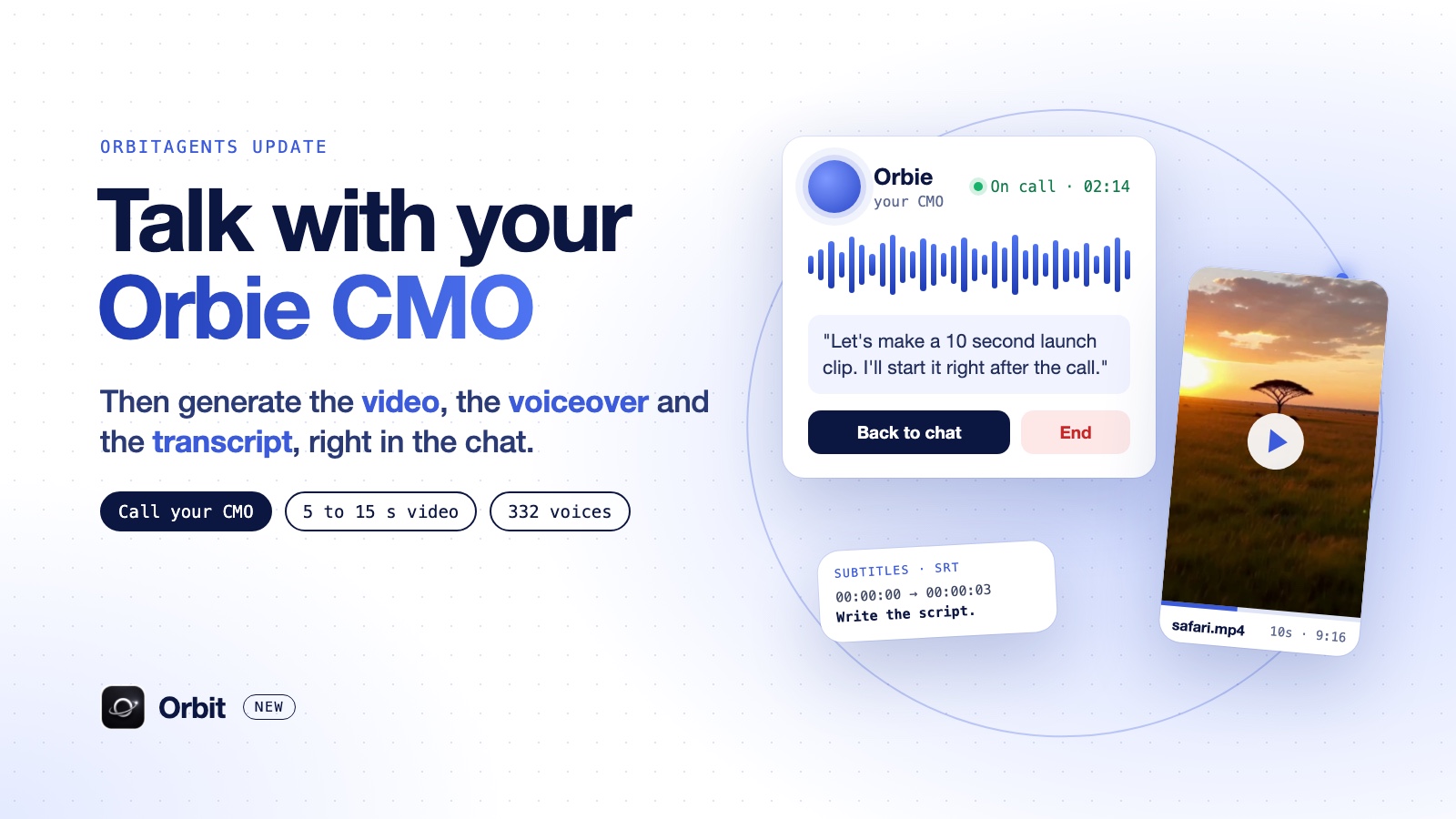
Orbit is chat-first. You can talk to any agent, correct it by replying, and talk to Orbie, your AI CMO, who knows your business and can take a phone call to plan with you.
Verdict: Orbit if you want to direct agents in conversation. Paperclip if you prefer tickets.
8. Cost
Paperclip is free software. Your real costs are the AI models and subscriptions your agents run on, plus hosting if you run it on a server. Its budgets help you keep those costs in check.
Orbit has a free plan with 100 credits at signup plus 5 a day. Pro starts at $29 a month with 2,900 credits, and usage is charged at cost, where one credit is half a cent. Models, tools and data are included in the credits, so there are no separate API bills.
Verdict: Paperclip is cheaper if you already pay for models and have time to run it. Orbit is simpler to budget because everything is in one bill.
Where Paperclip wins
We want to be fair here, because Paperclip is a genuinely good product.
- Control. It is open source, MIT licensed and self-hosted. You can read every line and run it anywhere.
- Any agent. If you already use Claude Code, Codex or OpenClaw, Paperclip organizes them without asking you to switch.
- Governance. Budgets with hard stops, board approvals, review stages and an audit log go further than most platforms.
- Engineering work. Its roots are in coding agents, PRs and technical teams, and it shows.
- Community. More than 110,000 GitHub stars and a fast-moving roadmap.
Where Orbitagents wins
- No setup. You start from your website, not a terminal.
- Agents included. Ready-made agents for finding customers, outreach and content, with the tools already wired in.
- Memory. One shared memory across every agent and AI tool, with a briefing before every run.
- Growth channels. LinkedIn, email, WhatsApp, social media and a real browser, with safe daily limits.
- A strategist on top. Orbie, your AI CMO, plans with you in chat or on a call.
Can you use both?
Possibly, and it might suit some teams. Paperclip can connect to custom MCP servers, and Orbit's memory is reachable through one MCP link. In principle, that would let agents running in Paperclip read and write the same memory as your Orbit agents, so your engineering agents and your growth agents share one source of truth. We have not tested that setup end to end yet, so treat it as an idea, not a recipe.
Which one should you choose?
Answer these in order.
- Do you want to self-host, or must your data stay on your own servers? Choose Paperclip.
- Are your agents mostly about code, engineering or internal operations? Choose Paperclip.
- Do you already have agents you like and just need to organize them? Choose Paperclip.
- Do you want agents finding customers, running outreach and posting for you this week? Choose Orbit.
- Do you want your agents to remember what was decided, across every tool? Choose Orbit.
- Do you not want to install or maintain anything? Choose Orbit.
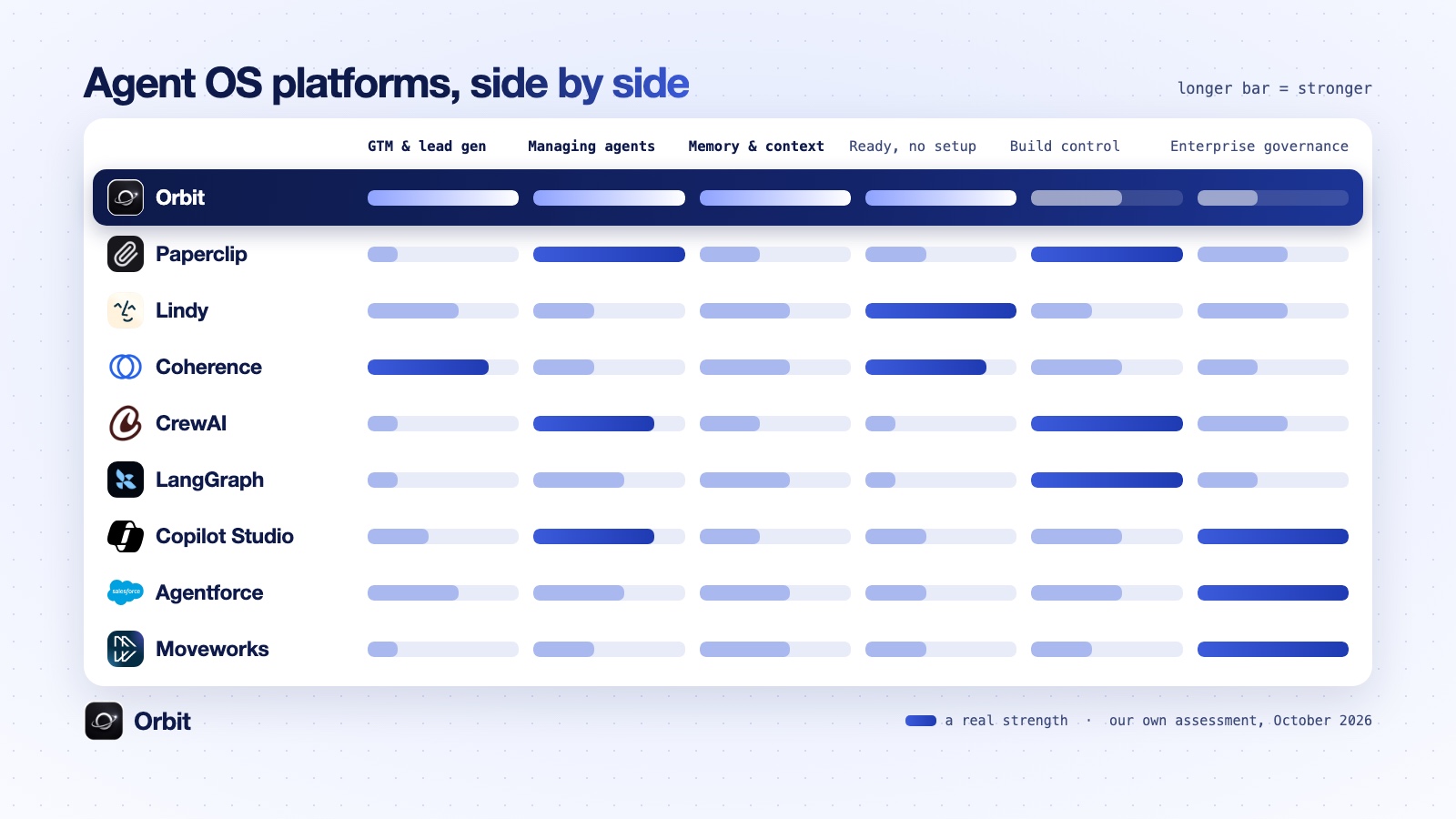
If you want a wider view of the category, our agent OS comparison looks at nine platforms side by side.
Paperclip runs a company made of agents. Orbit gives you agents that manage your growth.
For marketing teams, agencies and GTM professionals
If growth is your job, or your clients' growth is your business, this is where Orbit is built to fit.
Marketing teams use Orbit to keep content, social media and campaigns moving every day. Agents write posts in your brand's voice with images for each platform, research what your market is talking about, and draft for your review. Everyone on the team works from one shared memory, so the brand voice, the product facts and last week's decisions are the same for every agent and every person.
GTM professionals use Orbit as their outbound engine. Agents find people on LinkedIn, Reddit and X who just posted about the problem you solve, warm them up, connect and follow up within safe daily limits. Replies land in one inbox, and every person lands in one CRM with one card per person, so you spend your time in conversations, not lists.
Agencies and freelancers get the most out of agency mode.
- One workspace per client. Each client gets their own space with their own agents, results and people, under the client's own name and logo.
- One shared credit pool. All clients run on your one balance, with no fee per workspace and an optional monthly credit limit per client.
- Agents served from the cloud. Orbit provides the AI models and the tools itself, so agents run in Orbit's cloud for each client's business. Your clients do not need a Claude or ChatGPT subscription, an API key or a harness running on anyone's laptop. Most agent platforms, Paperclip included, still expect you to bring your own runtime.
- Your playbooks, repeated. Once a playbook works for one client, set up the same agents for the next one, with each client's own memory keeping the work specific to them.
That last point is the shift. Instead of selling hours, an agency can sell a team of agents that works for each client every day, run from one place.
Start free at orbitagents.com: enter your website, pick an agent and see what comes back in the first minute. If you run growth for clients, choose the Agency plan and add your first client workspace.
Frequently asked questions
- Is Paperclip free?
- Yes. Paperclip is open source under the MIT license and self-hosted, with no Paperclip account needed. You still pay for the AI models and subscriptions your agents run on, and for wherever you host it. A cloud version has a waitlist.
- Is Orbitagents open source?
- No. Orbit is a hosted product. There is a free plan with 100 credits at signup, and paid plans start at $29 a month.
- Which one is better for marketing and sales?
- Orbit, if you want agents that act on LinkedIn, email and social media with no setup. Paperclip can run research and content agents, but it does not name LinkedIn, email or CRM integrations, so you wire those up yourself.
- Which one gives me more control?
- Paperclip. You host it, choose every agent runtime, and control the code. Orbit trades some of that control for agents, tools and memory that work from the first minute.
- Can I use both together?
- Possibly. Paperclip supports custom MCP servers, and Orbit's memory is reachable through an MCP link, so Paperclip agents could read and write Orbit's memory. We have not tested that setup end to end.
Build your autonomous AI company
Orbit gives your AI clients shared memory, provisioned tools and agents that run like trained employees.
Get started free