AI Explained
The Agent OS: Is This the Future of Companies? Top 9 Comparison
Every era of business had an operating layer. The next one is built for teams of people and AI agents. What an agent OS is, the principles behind a good one, and how nine platforms differ.
Every era of business has been shaped by the system it ran on. Factories had the assembly line. Offices had the org chart and the filing cabinet. Modern companies have a stack of software, with people moving work between the tools by hand.
The next company will look different. A small team will set the direction, and many AI agents will do much of the work: finding customers, writing, following up, reporting. The question is no longer whether that is possible. It is what that company runs on.
For the last few years, almost all the attention went to the models. But anyone who has tried to run real work on agents knows the model is rarely what breaks. The agent forgets what it decided yesterday. It loses access to a tool. Nobody notices it stopped on Tuesday. Two agents contradict each other, and you find out from a customer.
None of those are intelligence problems. They are operating problems, the same kind every company has with people, and they are why the agent operating system has moved from research papers into product pages so quickly. An agent OS is to a company of agents what management, process and shared records are to a company of people.
The term is now used so loosely that it can mean almost anything, so this piece tries to pin it down: what an agent OS actually is, the layers every serious one needs, the principles that separate good ones from demos, and how nine platforms made different choices. Those choices will shape how the companies built on them work.
What an agent OS actually is
An agent OS is the layer that runs, coordinates and governs AI agents, the way a traditional operating system runs programs. A computer's operating system decides which program gets the processor, what memory it can touch, which files and devices it can reach, and what happens when it misbehaves. An agent OS makes the same decisions for agents, except the scarce resources are different: context, memory, tools, permissions and human attention.
The idea has a real research history. The AIOS paper, first published in 2024, argued that scheduling, context, memory, storage and access control should move out of individual agent applications and into a shared kernel. In June 2026, Ankur Sharma and Deep Shah described an agent OS as an agentic control plane built into existing operating systems, with responsibilities that include scheduling, memory, tool registries, policy and audit. They are explicit that the aim is not to replace Windows or Linux. It sits above them.
That is the most useful way to think about it. An agent OS does not replace your computer's operating system or your AI model. It is the missing layer between the model and the work.
Why agents need an operating system at all
Normal software is predictable. Given the same input, a program takes the same path, and when it fails it fails in ways you can trace. Agents are different in three ways, and each one creates a problem that ordinary software infrastructure was never designed to handle.
- Agents are probabilistic. The same goal can produce a different plan each time, so you cannot test every path in advance. You need limits and oversight while they run.
- Agents are long-lived. Useful work happens over days and weeks, not one request. Something has to remember, reschedule and pick up where the last run stopped.
- Agents act. A chatbot that gets something wrong gives you a bad answer. An agent that gets something wrong sends the email. Permissions and records stop being optional.
Then there is the multiplication problem. One agent in one chat window can be managed by hand. Five agents across Claude, ChatGPT and Codex cannot. Each has its own memory, its own connections and its own view of your business, and you become the integration layer, copying context between them. I wrote about what that feels like in how to manage multiple AI agents as a solo founder. An agent OS exists to take that job off your plate.
The six layers of an agent OS
Descriptions vary, but they converge. Slack's definition lists agents, orchestration, data access, context and memory, workflow logic and governance. The academic papers use schedulers, memory, tool registries and policy enforcement. Put them together and map them onto a classic operating system, and six layers emerge.
| Traditional OS | Agent OS layer | The question it answers |
|---|---|---|
| Process scheduler | Scheduling and triggers | When does each agent run, and what wakes it? |
| Memory management | Memory and context | What does this agent know right now? |
| Device drivers | Tools and connections | What can this agent reach and use? |
| Users and permissions | Identity and policy | What is it allowed to do, and as whom? |
| Inter-process communication | Orchestration | How do agents hand work to each other? |
| System logs | Observability and audit | What happened, why, and what did it cost? |
Scheduling is what turns an assistant into a worker. An agent that only runs when you open a chat is a tool. An agent that runs every morning, wakes on a new reply and retries after a failure is staff.
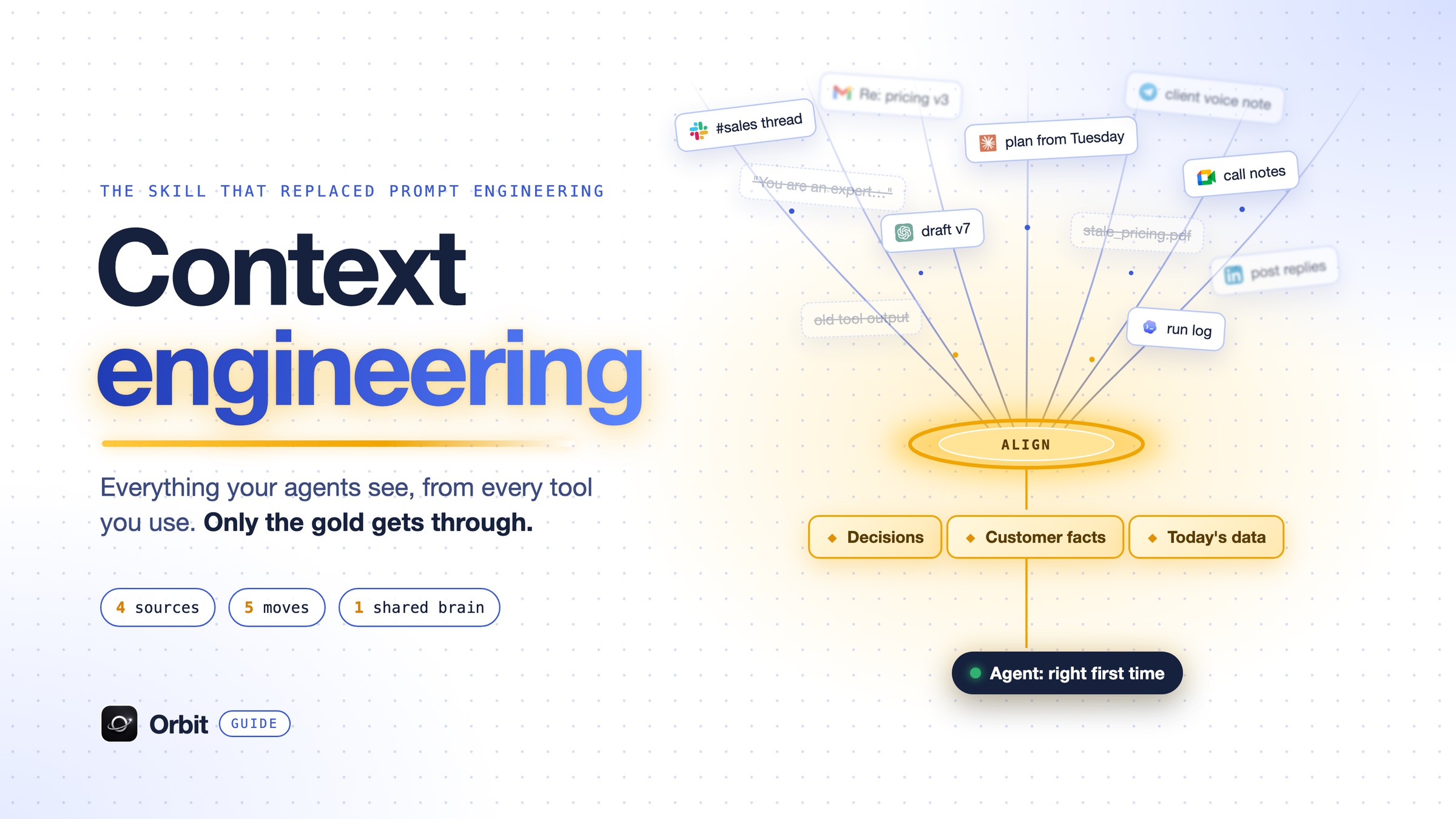
Memory and context is the layer most products get wrong, because the two are easy to confuse. Memory is what the system has stored. Context is the small slice of it that reaches the model for this step. A good OS manages both, which is the heart of context engineering.
Tools and connections are the drivers. Without them an agent can only talk. With them it can read a CRM, search the web and post. This layer is also where most setup pain lives, since every connection needs a key, a scope and maintenance.
Identity and policy decide whose name an agent acts in and where its limits sit. Orchestration decides how work moves between agents without a human relaying it. Observability closes the loop, because you cannot trust what you cannot see.
Seven principles of a good agent OS
Having all six layers is not enough. What separates a real operating system from a pile of features is the principles it was built on. These are the ones I think matter most.
1. Separate the agent from the runtime
This is the original insight of the AIOS work. If every agent carries its own memory, tools and scheduling, you get the same plumbing rebuilt over and over, and none of it is shared. Move those services underneath the agents and each new agent becomes cheap. It is the same reason applications stopped shipping their own printer drivers.
2. Treat memory as shared infrastructure
Private memory per agent recreates the silo problem inside your own system. Your outbound agent should know what your support agent learned yesterday. Shared memory also needs ranking: a decision the founder made should outweigh a guess an agent wrote down at 3am. Without provenance, more memory just means more confident mistakes.
3. Schedule context, do not dump it
More context does not make agents better. Past a point it makes them worse, because the model has to find the signal in the noise and pays for every token. A good OS treats the context window the way a classic OS treats RAM: scarce, actively managed and loaded on demand.
4. Give agents capabilities, not keys
An agent should receive specific abilities, not a raw credential that can do anything. Permissions should work per tool and per action, with a middle setting between yes and no. Paperclip's gateway is a good example, with actions set to Allowed, Ask first or Off. That middle setting is where most real business actions belong.
5. Keep a human in command
Full autonomy makes a great demo and a risky business. Anthropic's guidance on building agents describes agents pausing at checkpoints or when they hit blockers, and that is the right default. The OS should make approval cheap: a single inbox of what is waiting on you, not a dashboard you have to go looking through. As trust grows, you move the checkpoints further out.
6. Be deterministic where you can
Anthropic's other point in that piece is just as important: use the simplest solution that works, and add complexity only when it is needed. Not every step needs a model making a judgment call. A good OS mixes fixed steps with agent reasoning, so checking a list is code, and deciding what to say is the agent. It is cheaper, faster and easier to debug.
7. Build on open protocols
An agent OS that only works with one model or one vendor is a walled garden, and models keep changing. MCP, announced by Anthropic in November 2024, standardised how agents reach tools and data. A2A, announced by Google in April 2025, targets how agents talk to each other. Betting on these keeps you free to swap models as the leaderboard changes.
The real architectural differences
Most platforms would claim those principles. The differences show up in five design choices, and once you see them, the market stops looking confusing.
Where does it run? Some run on your own machine or servers, which gives you control and leaves you the maintenance. Some run in the vendor's cloud, so agents work while your laptop is closed. A few do both.
Who supplies the agents? Some platforms orchestrate agents you bring. Some ship ready-made agents. Frameworks give you the parts and expect you to build.
Who supplies the tools? This is the most underrated difference. If you bring your own keys and connections, you own the setup work forever. If they come wired in, you can start in minutes, but you depend on what the platform offers.
Where does memory live? It can sit with each agent, in a shared layer across agents, inside a system of record such as your CRM, or in an enterprise data platform. That one decision shapes what your agents can know.
What is the centre of gravity? Every product is really organised around one thing: code, an assistant, a CRM record, an enterprise stack or a business outcome.
Those choices sort the market into four kinds of agent OS:
- Developer frameworks. Centred on code. You build everything. LangGraph and CrewAI live here.
- Enterprise control layers. Centred on an existing stack and its governance. Copilot Studio, Agentforce and Moveworks.
- AI teammates. Centred on an assistant or a record. Lindy, and Coherence inside a CRM.
- Operator platforms. Centred on running a team of agents as a business. Paperclip and Orbit.
Nine platforms compared
Here is how those choices play out in practice.
| Platform | Best for | You bring | Starting price |
|---|---|---|---|
| Paperclip | Technical founders who want to self-host | The agents and their tools | Free, open source |
| Lindy | Teams that want one assistant in Slack | Your work apps | $49.99/mo |
| Coherence | Small teams who want CRM with agents | Your customer data | Free tier, then per user |
| CrewAI | Developers building multi-agent systems | Engineers | Free tier, Enterprise custom |
| LangGraph | Developers who need fine control | Engineers | Free, open source |
| Copilot Studio | Microsoft 365 companies | An Azure subscription | $200 per 25,000 credits |
| Agentforce | Salesforce companies | Salesforce data | $2 per conversation |
| Moveworks | Large workforces on ServiceNow | An enterprise contract | Not published |
| Orbit | Founders and small teams running GTM with agents | A goal | Free, paid from $29/mo |
Prices are from each vendor's own pricing page on October 30, 2026 and change often.
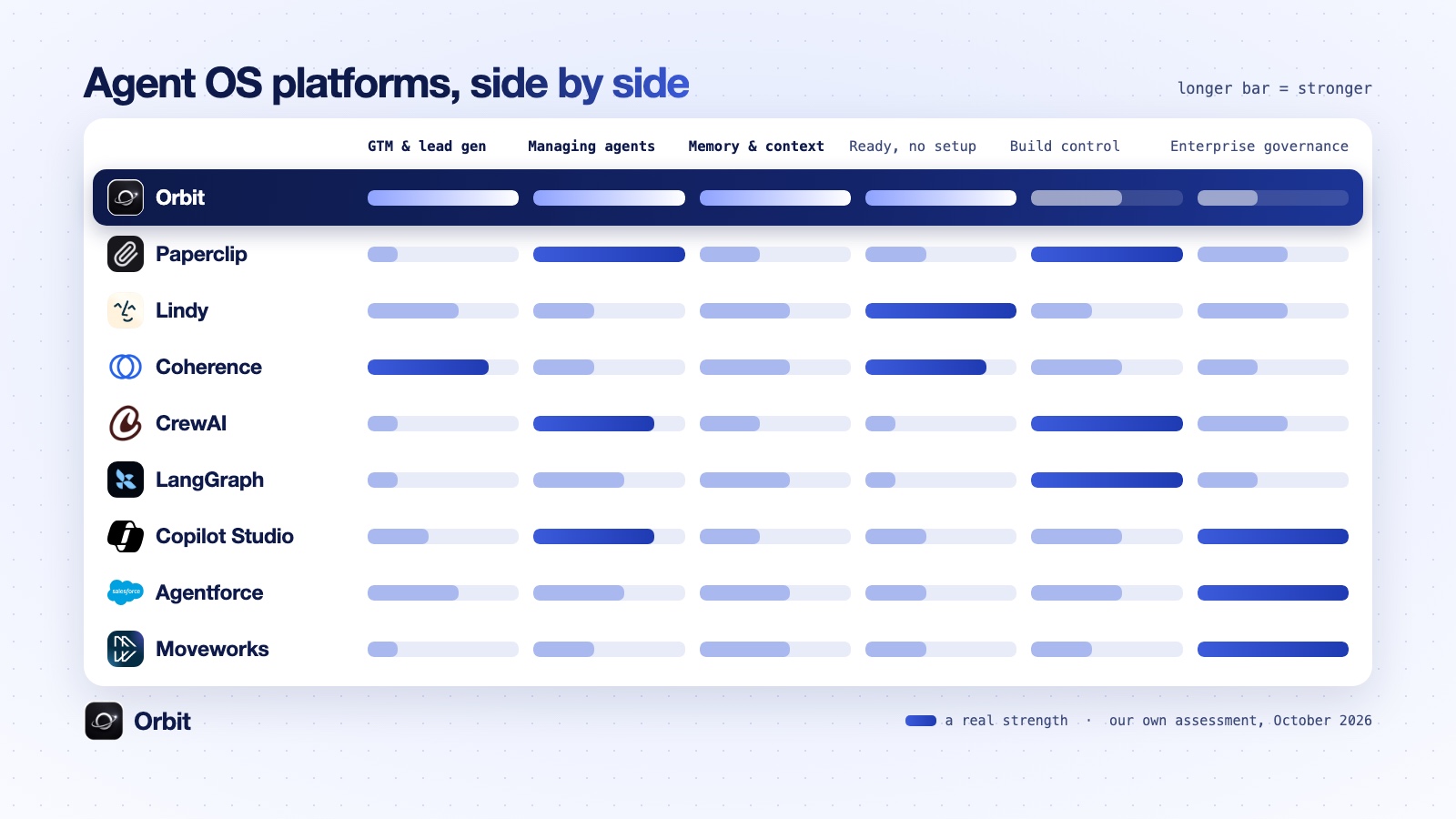
Each platform shines in different places, which is the whole point. Here is how they compare across six areas. These ratings are our own assessment, so treat them as a guide rather than a benchmark.
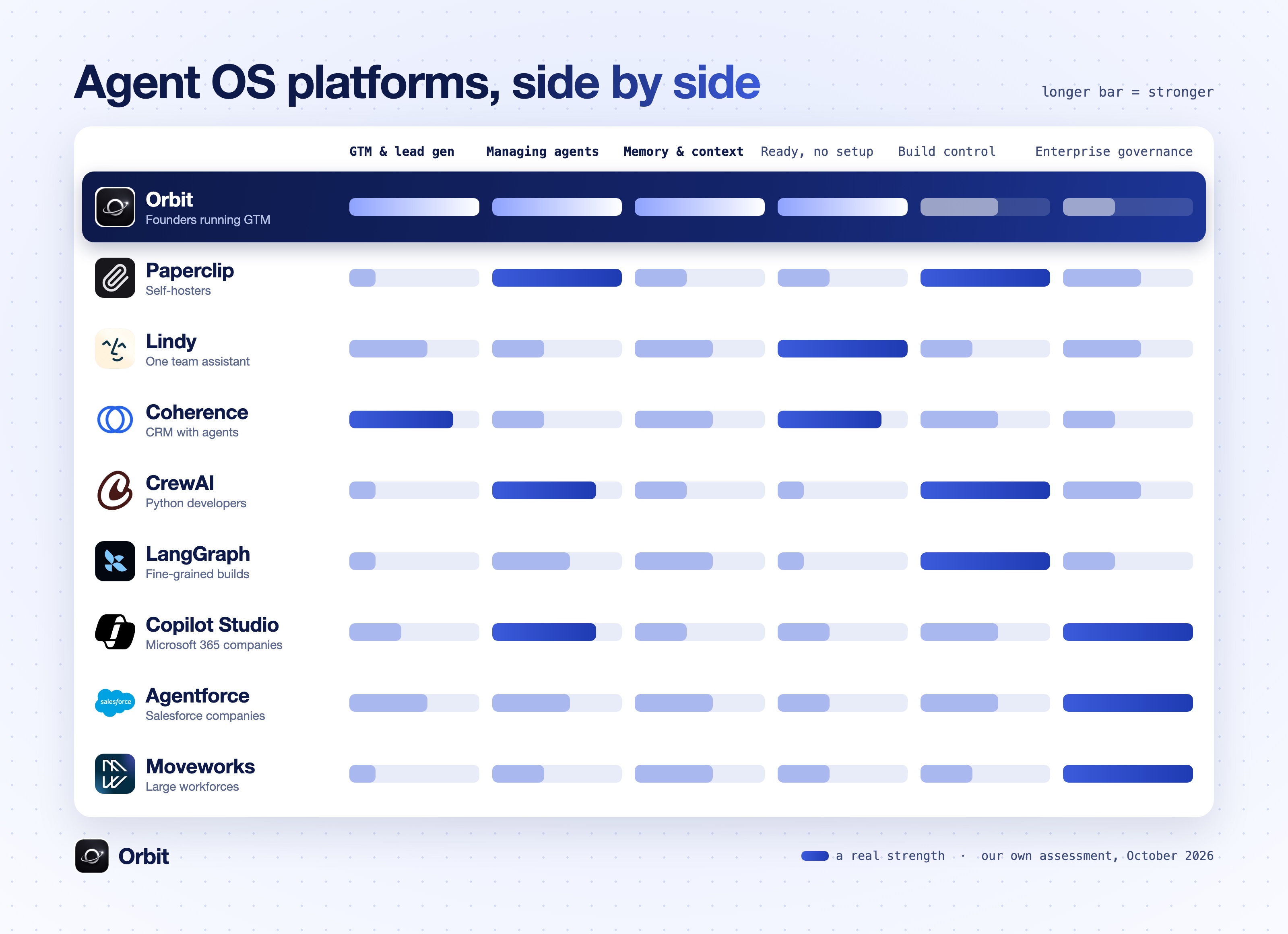
The pattern is clear. Paperclip and the frameworks lead on control, the Microsoft, Salesforce and ServiceNow products lead on governance, and Lindy is among the fastest to get going. Orbit leads where a founder's growth work happens: GTM, managing agents, and memory and context.
Paperclip
Paperclip is the closest thing to a direct competitor, and it is very good. It treats your agents as a company: an org chart, goals, monthly budgets per agent, scheduled heartbeats and a board that approves hires. Its headline is "A team of agents for every person."
It wins on control. It is MIT licensed, runs on your machine with one command, needs no account, and has real momentum, with about 109,000 GitHub stars. If you are comfortable running infrastructure, start here.
The trade-off is in its own design: it does not tell you how to build agents, and none are installed for you. You connect Claude, Codex, Cursor or OpenClaw yourself and wire up their access. Memory and knowledge are still marked in progress on its roadmap.
Lindy
Lindy is an AI teammate that lives in Slack, iMessage, email and the browser, and a whole team shares one Lindy. It takes meeting notes, runs routines, handles an inbox and connects to over 1,500 integrations.
It is the most polished way to give a team one capable assistant with little setup. The pricing page lists Team at $49.99 a month for 5,000 credits, pooled across the team. The trade-off is the shape of the product: it is one assistant doing many jobs. If you want several specialised agents with their own schedules, data and pipelines, you will be stretching it.
Coherence
Coherence calls itself "The Agentic Customer Operations Platform." It is a CRM first, with two-way email sync, custom modules, campaigns, websites and an agent called Nash, all on one data model, for small teams, agencies and consultants.
Its architecture makes a clean argument: put the agents where the customer data already lives. If scattered customer data is your main problem, that works well. The trade-off is that you are moving into a new CRM rather than connecting what you already use.
CrewAI and LangGraph
These two are the default choices for builders, and they are frameworks, not products you log into and run a business from.
CrewAI is an MIT-licensed Python framework for role-playing agents that collaborate, with about 60,000 GitHub stars and a hosted free tier of 50 workflow runs a month. LangGraph is a lower-level, MIT-licensed runtime for developers who want precise control over each step.
If you have engineers and want to own every decision, either is a better foundation than any platform here. You are effectively building your own agent OS on top of them. If you do not have engineers, they are the wrong tool.
Copilot Studio, Agentforce and Moveworks
All three are strong for the same architectural reason: they sit inside systems a large company already runs, so identity, data and policy are already solved.
- Microsoft Copilot Studio builds agents across Microsoft 365, with 1,500+ connectors, MCP support and governance through Entra and Purview. It needs an Azure subscription.
- Salesforce Agentforce runs on your Salesforce data, from $2 per conversation or $125 per user a month as an add-on.
- Moveworks is an AI assistant for a whole workforce, now part of ServiceNow, which completed the acquisition in December 2025.
If your company already pays for one of these stacks and has IT behind it, use it. For a founder or a five-person team, the setup and pricing assume a department you do not have.
Beam AI, which literally brands its engine Agent OS, and Relevance AI, which sells an "AI Workforce," also sit closer to this end. Both route you to sales for pricing.
Where Orbit fits
Orbit made its architectural choices for one job: go-to-market. It runs your marketing, lead generation and outbound flows with AI agents, and it manages those agents and their shared memory and context in one place. Our line is "Build the AI empire that runs with you, the operating system for Claude, Codex, ChatGPT and more," and the important words are "runs with you." You stay in command.
Most tools on this list either manage agents or do growth work. Orbit does both, and that comes from how the design choices above were made:
- Agents and GTM tools come wired in. Lead data, scraping, image generation and X and Reddit data work with no API keys, and agents can act from your connected LinkedIn, Gmail and other accounts. You pick an agent and run it.
- It runs where you want. On Orbit's own cloud, on a schedule or from chat, with nothing to install. Or inside your own Claude, Codex, ChatGPT or Cursor through one MCP link, using the same memory.
- Every agent shares one memory. What one agent learns, the others can use, with sources and trust levels attached. I wrote more about that journey in from AI second brain to agent OS.
Where Orbit loses: if you need to self-host, Paperclip is the answer. If you need deep custom logic, a framework gives you more control. If you are an enterprise standardised on Microsoft or Salesforce, stay there. And everything on Orbit is metered in credits, so it is not unlimited.
The future of companies
This is my view rather than a fact, but I expect four shifts in how companies work.
Companies stay small for longer. Headcount used to be the way to add capacity. When agents can take on the repeatable work, a few people can run what once needed a department. The advantage moves to whoever directs agents best, not whoever hires fastest.
The company's memory becomes its most valuable asset. Models will keep improving and keep getting easier to swap, so they stop being the edge. What stays yours is the layer that holds your decisions, customers, voice and history. A new hire takes months to learn how your company thinks. An agent on a shared memory knows on day one. Whoever owns that layer owns how your company works.
Agent operating systems will specialise. Desktop, server and mobile each ended up with different operating systems because the jobs were different. I expect the same here: one for engineering, one for enterprise IT, one for growth. The companies that choose well will pick the one built for their main job.
People move from doing to deciding. The human role gets bigger, not smaller. As agents take on more of the doing, the work shifts to setting direction, judging quality and approving what matters. The best agent OS is the one that makes you a better operator, not the one that promises you can leave the room. That is why we say "runs with you," not "runs itself."
The org chart of the future will not be people only. It will be a few people, many agents and one shared brain, and the agent OS is what holds them together.
How to choose
Answer these in order and stop at the first yes:
- Do you have engineers who want to build agents themselves? Use CrewAI or LangGraph.
- Is your company standardised on Microsoft, Salesforce or ServiceNow? Use the agent layer you already own.
- Do you want to self-host and bring your own agents? Use Paperclip.
- Do you need one good assistant for your team? Use Lindy.
- Is your real problem customer data? Look at Coherence.
- Do you want a team of agents running your marketing and lead generation, with no setup? Use Orbit.
If you want a deeper look at one matchup, we compared the same way in n8n Agents vs Orbit.
If you want to start building that kind of company, Orbit is free to start with no card: 100 credits, then 5 more every day. Choose agents, watch them work.
Frequently asked questions
- What is an agent OS?
- An agent OS is the layer that runs, coordinates and governs AI agents, much as an operating system runs programs. It manages scheduling, memory and context, tools, permissions, orchestration and audit across more than one agent.
- Does an agent OS replace Windows or macOS?
- No. An agent OS sits above your normal operating system and your AI models. It is the layer between the model and the work, not a replacement for either.
- What is the difference between an agent framework and an agent OS?
- A framework such as CrewAI or LangGraph is code you use to build agents. An agent OS is where agents run, share memory and get managed, and it may come with agents ready to use.
- What is the difference between memory and context?
- Memory is everything the system has stored. Context is the small part of it that reaches the model for a given step. A good agent OS manages both, so agents get what they need without being buried in noise.
- What is the best agent OS in 2026?
- It depends on the job. Developers should look at CrewAI or LangGraph, Microsoft and Salesforce companies at Copilot Studio or Agentforce, self-hosters at Paperclip, and founders who want agents running marketing and lead generation with no setup at Orbit.
- Do I need to code to use an agent OS?
- Not always. Frameworks need engineers and Paperclip suits technical users. Lindy, Coherence and Orbit are made for people who do not code.
Build your autonomous AI company
Orbit gives your AI clients shared memory, provisioned tools and agents that run like trained employees.
Get started free