Playbooks
How to Manage Multiple AI Agents as a Solo Founder Without Losing Your Mind
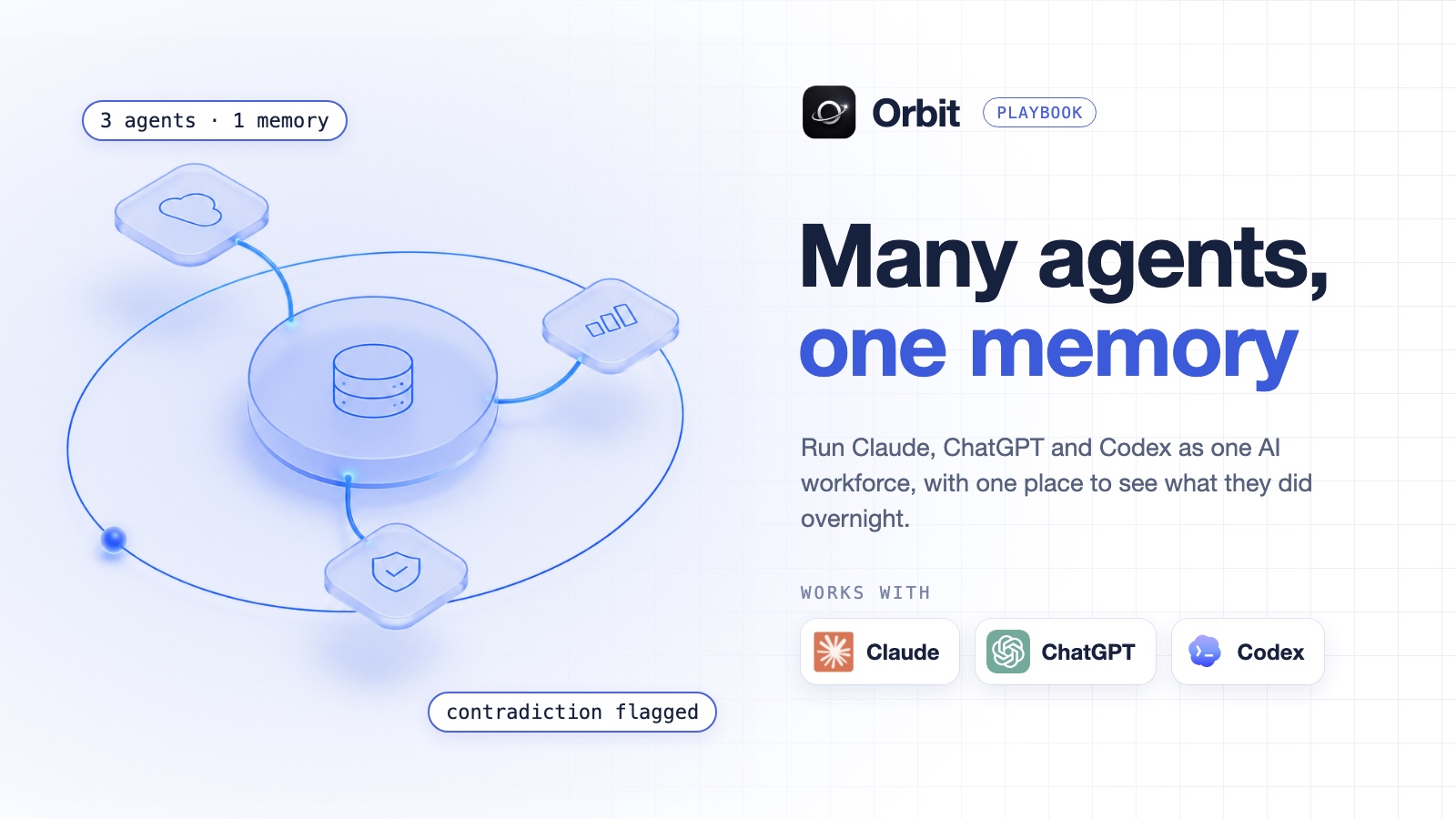
A practical system for running Claude, ChatGPT, and Codex as one AI workforce, without seven disconnected tabs and no idea what any of them did yesterday.
If you're a solo founder running more than two AI agents right now, I can guess what your setup looks like. A Claude tab for the coding agent. A ChatGPT tab for research. Maybe a Codex session doing something in the background you half remember starting. A Notion doc you meant to update three days ago with "what each agent is supposed to be doing." No shared memory between any of them. No way to see, at a glance, what got decided yesterday versus what's still open.
That's not an AI problem. That's a management problem, and it's the same one you'd have with human employees who never talked to each other and kept no notes.
I've spent the last few months building Orbit specifically because I hit this wall myself. Here's the system that actually works, and why most of the fixes people reach for first don't solve it.
The real problem isn't memory, it's coordination
Search "AI agent memory" and you'll land in a crowded field of memory tools, all promising your agent will "remember" the last conversation. That's a real feature, and shared memory across agents is where it gets useful. But memory alone solves the wrong layer of the problem for a founder running a business.
Memory tells one agent what it said last time. It does nothing for the actual question you're asking at 9am: what did all of my agents do while I was asleep, what did they decide, and is anything about to contradict something I already settled last week?
That's coordination, not memory. And it's the part a plain memory API isn't built for.
What "no visibility" costs you in practice
A few ways this shows up if you're running agents solo:
- You re-explain context every session. The pricing model you finalized on Tuesday gets re-litigated by a different agent on Thursday because it never saw the decision.
- You can't tell what's actually running. Three agents, three tabs, and the honest answer to "what is my AI doing right now" is "I'd have to go check."
- Contradictions ship silently. One agent writes copy using an old tagline. Another quotes a price you changed last month. Nobody flagged it because nothing was watching for it.
- Nothing compounds. Every agent starts from zero instead of starting from what the last one figured out. You're paying for intelligence and getting amnesia.
None of this is a "your agents aren't smart enough" problem. Claude, GPT, and Codex are all plenty capable. It's an infrastructure gap sitting underneath all of them.
The system: give every agent one shared source of truth
Here's the actual practice I run, independent of whichever tool you use to implement it.
1. Every agent reads active decisions before it acts
Before an agent starts a task, it should pull the current, ratified state of your business decisions, not just its own chat history. Pricing, positioning, standing rules, whatever's locked. If an agent can't see what's already been decided, it will re-decide it, badly, on its own.
2. Contradictions get flagged, not shipped
When an agent is about to produce something that conflicts with an existing decision (a stale price, a retired tagline, a reversed policy), that should surface before the output goes out, not after a customer catches it.
3. One decision reaches every agent, not just the one you told
You shouldn't have to manually paste "we changed the refund policy" into five different chat windows. Broadcast it once, and every agent that touches that topic picks it up on its next run.
4. You can see what's running, right now, in one place
Not a log file you'd have to grep. A live view: which agents ran today, what they produced, what's still open, what needs your sign-off before it goes out.
This is the shape of the problem, and it's what an agent OS for solopreneurs is for: one layer above your AI tools that gives every agent the same memory and gives you one place to see the work. That's what I'm building Orbit to be, the operating system for your AI workforce. Build the AI empire that runs with you, not one where you're the only thing holding seven disconnected tools together.
What this looks like day to day
With this system in place, a normal morning looks like this: you open one dashboard and see what every agent (Claude, ChatGPT, Codex, whatever else you're running) did overnight, what's waiting on your approval, and what got flagged as a contradiction. You approve, reject, or redirect from that one place. No tab-hopping, no "wait, which agent was doing the pricing page again."
That's the difference between running a fleet of AI agents and babysitting a pile of disconnected chat windows. Orbit is where that shared memory and that one view live, built for founders and small teams who are running their operations on AI agents instead of a headcount.
Start with one thing this week
You don't need to rebuild your whole stack to get the first win. Pick the decision your agents contradict each other on most (pricing is usually the worst offender) and put it in exactly one place every agent has to check before it writes anything about pricing. That alone will catch the most expensive class of mistake.
If you want the fuller system, that's what Orbit is built for: shared memory across Claude, Codex, ChatGPT and more, a live view of every agent's activity, and a flag when agents contradict each other. Take a look at orbitagents.xyz if you're running more than one agent and starting to feel the coordination tax. For the one-person-company version of all this, see the agent OS for solopreneurs page.
Frequently asked questions
- Do I need a dedicated tool to coordinate multiple AI agents, or can I do this manually?
- You can do a rough version manually with a shared doc everyone reads and updates, but it breaks down fast because agents don't reliably check it and nothing flags contradictions for you. It works as a stopgap, not a system.
- Is this the same as giving an agent long-term memory?
- No, and that's the point. Long-term memory helps one agent remember one conversation. Coordination is about every agent, across every tool, sharing the same source of truth and catching conflicts between them. You can have great memory and still have zero coordination.
- Which AI tools does this work with?
- The system applies regardless of which agents you're running. Orbit is built to work across Claude, Codex, ChatGPT and more, since most solo founders aren't running just one.
- How much time does this actually save?
- It's less about hours saved and more about mistakes avoided: the stale price that goes out, the re-litigated decision, the afternoon spent working out what an agent already did.
Build your autonomous AI company
Orbit gives your AI clients shared memory, provisioned tools and agents that run like trained employees.
Get started free